Tag: reinvent strong

  • #006. Why Your Body Needs More Fuel – Not Less – After 45

    #006. Why Your Body Needs More Fuel – Not Less – After 45

    Hey there, it’s Becky

    The pattern you might recognise

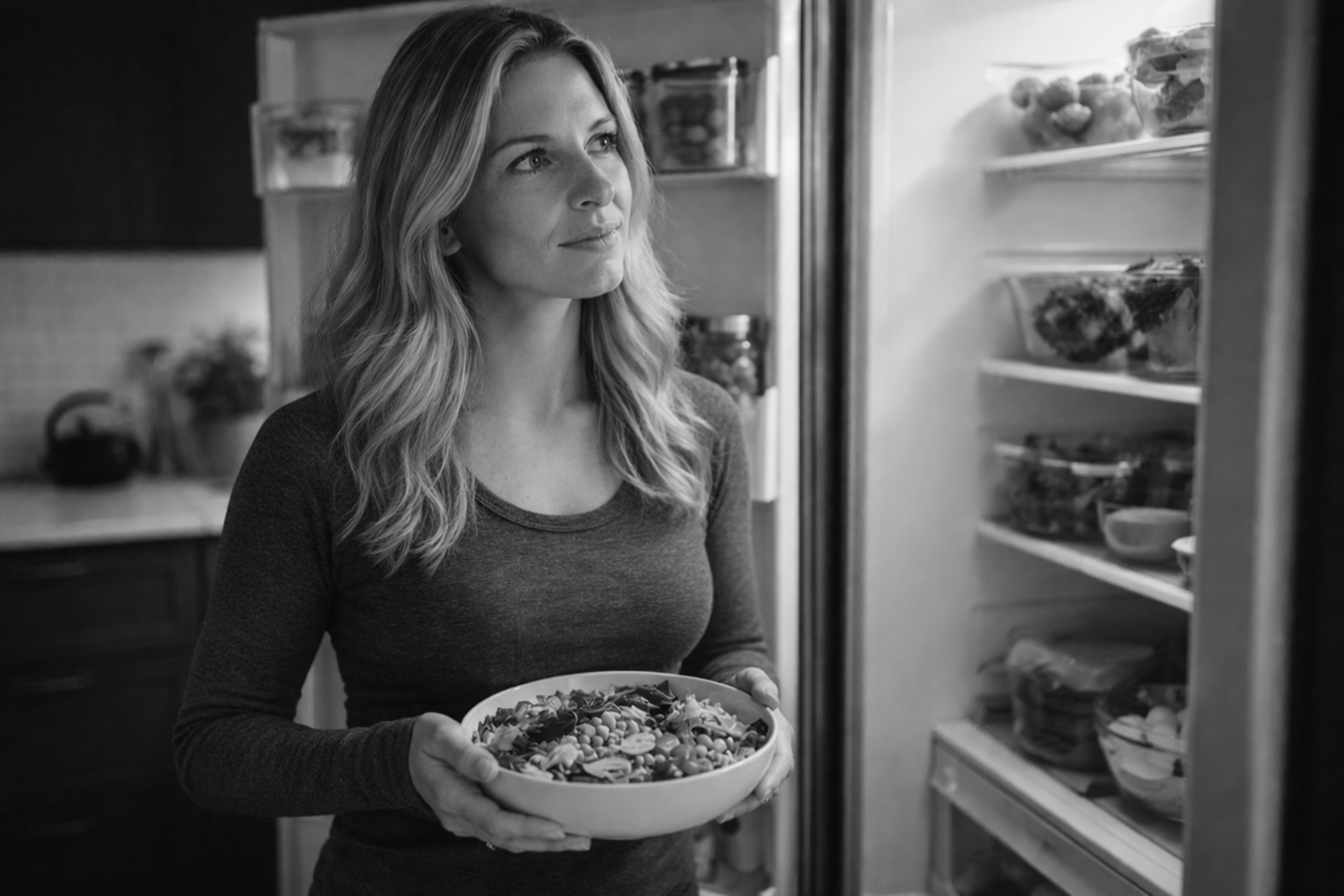
    If you’re over 45, there’s a good chance you’re not eating enough – not intentionally, not dramatically, just quietly. Maybe you skip meals because the day gets busy. Maybe you go long stretches without eating. Maybe you train fasted because it feels disciplined. Maybe you try to “be good” by keeping calories low.

    It feels controlled. It feels responsible. It feels like the right thing to do.

    But over time, it drains your energy, flattens your mood, reduces the quality of your workouts, and makes motivation quietly disappear.

    It’s not a willpower issue – it’s under‑fueling

    Your life now carries more responsibility, more mental load, more stress, more broken sleep, and more demands on your body. And yet, without realising it, you may be eating less than your body actually needs.

    Not because you don’t care – but because the messaging around midlife fitness has become a confusing mix of intermittent fasting, fasted workouts, calorie restriction, sugar avoidance, and the idea that eating less is always better.

    It isn’t. And it certainly isn’t sustainable.

    Intermittent fasting isn’t the problem – the timing is

    I’ve tried every version of fasting over the years. What actually works at this stage of life is simple: let the night do the work.

    Finish your evening meal and allow the overnight hours to be your fasting window. That’s where the benefits happen – without compromising your energy or your training.

    What doesn’t work is skipping breakfast, delaying food until late morning, or training fasted. Those approaches create unstable energy, irritability, poor recovery, lower training quality, increased cravings, and a slow erosion of your Feel‑Good Factor.

    You need to eat – especially around your workouts

    This is the part many women get backwards.

    You might restrict before training because you think you should. You might restrict after training because you want to “be good.” You might try to earn your food or keep calories low on training days.

    But the truth is simple: the more quality effort you put in, the more fuel you need. Fasted training doesn’t build resilience. It builds depletion. And depletion is the fastest route to feeling flat, frustrated, and stuck.

    Protein is the quiet foundation

    Eating good‑quality protein with every meal is one of the most reliable ways to maintain lean muscle, support strength, stabilise appetite, improve recovery, and keep your metabolism running well.

    Most women under‑eat protein without realising it. When protein is low, everything becomes harder – hunger regulation, energy stability, training quality, and even mood.

    The basics still matter

    The foundations aren’t glamorous, but they work. Three real meals a day. Eating regularly instead of stretching long gaps. Choosing whole foods more often than processed ones. Building meals around protein and vegetables. Drinking enough water, tea, or coffee to stay hydrated. Keeping alcohol lower because it disrupts sleep and energy more than people realise.

    None of this is restrictive. It’s supportive.

    The real issue: energy

    When you under‑eat, the first things to drop are your mood, your patience, your workout quality, your recovery, and your motivation. The day feels heavier. Everything feels like more effort than it should. This isn’t a character flaw. It’s physiology. A body that isn’t fuelled can’t produce energy. And a body without energy can’t produce momentum.

    The outcome — what eating enough actually gives you

    When you fuel properly – especially around your workouts – something shifts. Your energy becomes more stable. Your workouts feel better. Your recovery improves. Your mood lifts. Your day feels smoother. You feel more vibrant moving through your life. And your Feel‑Good Factor – the one that comes from being nourished, not restricted – begins to return.

    This isn’t about eating more for the sake of it. It’s about eating enough to support the life you’re living and the strength you’re building.

    If you have any questions about this, hit reply and let me know.

    Until next week…

    Momentum Wins.

    Rebecca

    You Might Also Like These:

  • #005. Why doing the only sport you love can quietly break you down

    #005. Why doing the only sport you love can quietly break you down

    Hey there, it’s Becky

    The part no one tells you…

    Strength matters as we age. So does stamina. None of that is controversial.

    What is rarely discussed – and what I learned the hard way – is that doing only one thing well is rarely enough for long‑term resilience.

    If the gym is the only place you can move right now, that is still a win. You are loading your body. You are showing up. Any movement is better than none.

    But over time, something else starts to matter.

    Carryover.

    Does what you’re doing prepare you for life outside that environment?

    Specialisation without support

    I’ve seen this across all ends of the movement spectrum, and I’ve lived it myself.

    There are people who lift consistently and look strong, but struggle the moment movement becomes unpredictable. A hill, uneven ground, a long swim, a full day outside with family – even running for a bus – suddenly feels harder than it should.

    There are master‑level cyclists riding huge weekly volumes. They are powerful, committed, disciplined – but often missing regular weight‑bearing work. Over time, that absence shows up quietly in bones, joints, back aches, and overall robustness.

    There are runners who never lift or vary their movement. Eventually, running too much starts to feel punishing rather than freeing.

    None of this happens overnight, which is why it’s easy to miss.

    My own wake‑up call

    I’ve had seasons where I cycled almost exclusively. My stamina and cycling strength were excellent. I could ride for hours and felt very fit. I never felt the need to move in any other way.

    But when I returned to running, the adaptation was poor. My lower core was sore. My hips and stabilisers struggled. Even walking normally took a few days to feel natural again.

    When I went back to swimming after time away, my shoulders, lower back, and even my breathing muscles told the same story.

    And when I tested something simple – like push‑up strength for my age – I couldn’t do one.

    That wasn’t failure. It was specialisation without foundation.

    The body adapts specifically – and deconditions specifically

    The body becomes efficient at what we repeatedly ask of it. It also quietly deconditions everywhere else.

    Doing only what we love often feels sustainable in the short term. In the long term, it can narrow us.

    The answer is not to abandon the thing you enjoy most. It’s to support it.

    The Anchor, the Antagonist, and the Armour

    Cycling is still my main sport. It’s the Anchor – the thing I love most.

    Around that, I deliberately layer in two other elements:

    The Antagonist. The movement that balances the Anchor. For me: short runs or longer power walks – weight‑bearing, impact‑based, bone‑loading.

    The Armour The strength that protects everything else. For me: lifting 2–3 times a week – resistance, control, multi‑plane strength.

    Sometimes I add swimming for upper‑body strength, breathing capacity, and mobility. In winter, I might trade a run and a lift for cross‑country skiing – full‑body strength and stamina outdoors in a single session.

    Nothing is fixed forever. Everything is phased. Variety in both sports and terrain keeps my all‑round strength building while maintaining interest in my main sport.

    This isn’t about doing more

    It’s about doing enough of the right, opposing inputs so the body stays adaptable and ready for life’s physical demands.

    And it’s about the foundations that make all of this work:

    • Sleep – the real recovery process starts with sleep.
    • Fuel – nourishment before, during and after sessions
    • Recovery – built into your weeks, months and years cyclically, not added as an afterthought!

    These are not extras. They are the architecture.

    The outcome – what all of this actually gives you

    When you support your main sport instead of relying on it alone, something shifts. Your body feels more energetic in everyday life. Your baseline steadies. The small aches ease. You recover faster. You feel more vibrant moving through your day. And your Feel‑Good Factor – the one that comes from being all‑round strong, not narrowly fit – begins to return…

    This is the real point of the Anchor, the Antagonist, and the Armour. Not optimisation. Not perfection. Just a body that holds you – in every season, on every terrain, and in the life you’re actually living.

    If you have any questions on the above letter, hit reply and let me know.

    Until next week…

    Momentum Wins

    Becky.

    You Might Also Like These Letters:

  • #002. Why All-round strength becomes non-negotiable after 45 (without gym culture)

    #002. Why All-round strength becomes non-negotiable after 45 (without gym culture)

    Hi there. It’s Rebecca.

    When I talk about strength, I’m not talking about the version most women have been shown. The gym‑culture version. The mirrors, the rigid plans, the performance metrics, the pressure to be disciplined first and enjoy it later. That world has never felt built for women in midlife, and you may be stepping back from it for good reason!

    Strength, at this stage of life, is something different. It’s quieter. More practical. More lived. It’s the kind of strength that supports your life rather than takes it over.

    And it’s definitely not triathlon training. You don’t need to turn your life into triathlon specific training to feel strong again (unless you want to). In fact in many cases, the opposite is true – less is more. Less training volume. Less pressure on yourself. More room for adaptability means a more responsive body.

    The moment you notice something has shifted

    There’s usually a moment when this lands. It’s rarely dramatic. It shows up in small, ordinary situations. You get up from the floor and feel a slight hesitation. You carry something heavy and notice you’re less steady than you expected.

    You have a busy day, and recovery takes longer than it used to. You feel a little more cautious where you once felt automatic. Nothing is wrong. Nothing is broken. But something has shifted.

    After 45, strength is no longer something you maintain by accident. It becomes something you either support, or slowly lose without noticing.

    Why the old “background strength” fades

    Earlier in life, movement alone often does the job. You’re naturally active. You recover quickly. Daily life provides enough challenge to keep muscles, joints, and bones working in the background.

    Over time, that background resilience fades unless it’s deliberately reinforced. Muscle mass declines. Bone density responds to load – or the absence of it. Joints rely more heavily on surrounding strength to stay pain‑free and confident.

    None of this announces itself loudly, which is why may only notice it once things start to feel harder than they should.

    This isn’t about becoming strong in a dramatic or performative sense. It’s about staying steady in your own body, and confident in the life you’re living.

    When the Feel‑Good Factor leads, your body follows

    And yes – you still want to look good. You want to feel firmer, more athletic, more defined. That isn’t superficial. It’s human. The difference lies in what you’re building it from.

    When the focus becomes control – strict routines, over‑training, over‑restricting – it becomes harder to sustain.

    When the focus becomes your Feel‑Good Factor – all‑round strength, movement you enjoy, recovery you respect – your body responds in a way that looks and feels good without the pressure.

    Posture improves. Muscle tone returns. You look more athletic, naturally. Movement looks more confident. Energy shows up in the way you carry yourself.

    Aesthetics become the reflection of your Feel‑Good Factor, not the chase.

    Strength is built through variety, not one method

    One of the biggest misunderstandings around strength is the idea (as mentioned above) that it comes from one activity alone. In reality, all-round strength is built through variety – through terrain, seasons, and different demands placed on the body over time.

    Walking on uneven ground challenges balance and coordination. Cycling hills naturally loads the legs. Swimming builds full‑body strength without impact. Seasonal activities like cross‑country skiing demand rhythm, endurance, and power all at once. Simple resistance work at home protects muscle and bone.

    Each piece on its own may seem modest. Together, they build all‑round strength – the kind that holds up in real life.

    Why variety protects consistency

    One of the biggest reasons women give up moving as they get older isn’t a lack of discipline – it’s boredom. Doing the same activity, in the same way, all year round is hard to sustain, both mentally and physically.

    Variety keeps movement interesting. It spreads the load across the body. It reduces overuse injuries. It adapts naturally to the seasons and to your energy levels.

    When movement feels varied and natural, consistency becomes easier. And consistency is what actually protects your Feel‑Good Factor over the long term.

    Where lifting fits

    Lifting (resistance training) still matters. In fact, it’s non‑negotiable. But it sits as the foundation, not the headline. A small amount of deliberate resistance work protects and can build lean muscle, supports bone strength, and keeps joints resilient. It makes everything else feel easier. Hills feel lighter. Swimming feels stronger. Walking feels more confident. Think of lifting as the quiet insurance policy that supports the life you want to live – not something that replaces it.

    Strength you live, not perform

    In this space, strength is lived, not performed. It’s shaped by real environments and supported by simple, consistent resistance work. It’s flexible enough to progress over time without turning into a rigid system.

    There are no aesthetic obsessions here. No pressure to do everything perfectly. Just a calm, sustainable way of staying strong, steady, and confident, year after year.

    If this reframes strength for you – from something narrow and intimidating into something with variety and way more enjoyment – then it’s doing exactly what it should!

    Strength isn’t something you go and do with will-power. It’s something you grow into, through variety, momentum, and with a whole new body awareness.

    Until next week,

    Momentum Wins™

    Rebecca

    You Might Also Like These:

  • #001. When the Old Rules Stop Working: How to Build Strength That Lasts

    #001. When the Old Rules Stop Working: How to Build Strength That Lasts

    Hi there. It’s Rebecca.

    I’m glad you’re here – because if you’re reading this, you’re probably sensing a shift you can’t quite name yet. You’re doing many of the right things. You’re moving. You’re paying attention. You’re not careless with your health.

    And yet, something feels different.

    Not broken. Not dramatic. Just less predictable. Energy fluctuates. Recovery takes longer. You don’t bounce back the way you once did. And the most frustrating part?

    There was no clear moment when it changed.

    This is the point where you may start to wonder whether this is simply “how it is now.”

    It isn’t.

    What you’re feeling is not decline – it’s a change in responsiveness. After 45, the body doesn’t stop adapting. It simply stops being endlessly forgiving. The old rules – more intensity, more volume, more discipline – stop delivering the same return.

    The shift you can’t quite name

    What makes this phase unsettling isn’t pain or illness. It’s uncertainty. You don’t know whether what you’re feeling is temporary, something to push through, or the beginning of a slow decline you’re meant to accept.

    You may respond by trying harder – more structure, more restriction, more pressure – because that’s what worked before. But this stage of life isn’t asking for more force.

    …it’s asking for a different strategy.

    Why trying harder stops working

    Most advice aimed at women in midlife is built on outdated assumptions: push harder, tighten up, optimise everything, fix yourself, go to the gym and only do that. Or bike and do only biking or only running or only walking. You’re not failing. Your body is simply asking for something different…

    Strength, energy, and recovery no longer maintain themselves in the background. They need to be rebuilt and protected deliberately without overwhelm and with a structure that works with your physiology, not against it.

    When you shift from narrow fitness to all‑round strength – movement across terrains, seasons, and intensities – the body responds again. Not because you’re doing more, but because you’re doing what actually works now.

    Motivation is not your problem

    If you’ve been telling yourself you’ve lost motivation, here’s a reframe: you probably haven’t. When recovery is compromised, the brain lowers motivation on purpose. It’s a protective mechanism, not a character flaw.

    This is why if you’re usually a disciplined type, you may feel frustrated rather than lazy. The issue isn’t drive – it’s direction.

    Strength at this stage isn’t built by force. It’s built by margin. Margin to recover. Margin to adapt. Margin to absorb stress while still feeling strong. When that margin disappears, effort feels heavy even when you’re doing the right things. That heaviness isn’t weakness. It’s physiology doing its job.

    What actually works now

    This next reinvention chapter of your life isn’t about starting over. It’s about shifting from intensity to adaptability. Rebuilding all‑round strength, moving in ways that support your energy, and creating a rhythm that doesn’t rely on willpower alone.

    This is where variety becomes non‑negotiable. Not random variety. Not novelty. But structured, multi‑modal movement that rebuilds responsiveness:

    • Anchor – the sport or movement you love (if you have one).
    • Antagonist – movement that challenges your body using opposite muscles.
    • Armor – strength training (resistance work) that protects it all.

    When you train with enough margin to recover, enough variety to stay adaptable, and enough strength to support everything else, something shifts quietly but unmistakably. Energy steadies. Strength builds in a way you can feel. The body responds with a reliability you may not have felt in years. And that familiar sense of “I’m back” – the Feel‑Good Factor – returns as a physical truth, not a fleeting mood.

    Why Build To Last™ exists

    You don’t need more intensity or more rules. What actually moves the needle is cutting through the noise out there and doing less rather than more. A training consistency that’s quality, smarter, and built to hold up in the week you’re living.

    This isn’t about punishment or perfection. It’s not about chasing a finish line or restarting every Monday. It’s about building all-round strength and energy that you reclaim now and stays with you – season after season, year after year.

    Momentum Wins™. Always.

    Rebecca

    You might be interested in these next Letters…